
Md Akhtaruzzman, PhD, Radiation Oncology Department, Evercare Hospital Chattogram, Bangladesh
Introduction
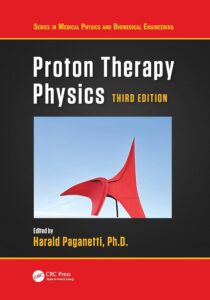
The third edition of Proton Therapy Physics, edited by Dr. Harald Paganetti, continues to set the gold standard in reference texts for particle therapy. This edition, published by CRC Press, comes at a time of rapid growth and innovation in the field of proton therapy. With increasing global investment in proton therapy facilities and technological breakthroughs such as pencil beam scanning, FLASH therapy, and adaptive planning. Dr. Paganetti is an internationally recognized expert in proton therapy and head of Physics Research at the Massachusetts General Hospital in USA has covered a comprehensive, scientifically rigorous volume that integrates foundation of physics, clinical applications, emerging research, and advanced computational modeling. This edition is not just an update but a significant evolution of the text, incorporating the latest developments in both clinical and theoretical aspects of proton therapy.
Structure and Content
The book is structured into six major thematic sections, with over 25 chapters contributed by global experts in proton therapy physics, biology, and engineering. The new edition places greater emphasis on evolving paradigms, such as biologically guided planning and real-time adaptive therapy.
1. Fundamentals of Proton Interaction and Beam Transport
The initial sectioncovers the basic physics of protons, including energy loss mechanisms, nuclear interactions, Bragg peak characteristics, and the influence of inhomogeneities. The principles of beamline design, gantry systems, and energy modulation are discussed in depth, with diagrams and system schematics providing practical insights into facility design and beam delivery.
2. Treatment Delivery and Planning Techniques
This section emphasis on passive scattering vs. pencil beam scanning (PBS) offer both historical perspective and technical comparisons. Extensive attention is given to PBS commissioning, scanning magnet control, and interplay effects in moving targets. Modern planning techniques, such as robust optimization, LET-weighted planning, and multi-field optimization (MFO), are well explained and include clinical case illustrations. Notably, this edition includes detailed discussions of proton arc therapy, range modulation strategies, and the implementation challenges of adaptive proton therapy.
3. Monte Carlo Methods and Analytical Modeling
The role of Monte Carlo (MC) simulation in proton therapy is increasingly important, and this edition offers a clear, thorough presentation of its physics and clinical utility on several MC platforms including Geant4, TOPAS, and FLUKA, with validation data and comparisons to analytical models.
The section bridges the gap between theoretical modeling and clinical implementation, addressing topics such as variance reduction, uncertainty quantification, and patient-specific QA using MC-based systems.
4. Dosimetry, Calibration, and QA
The dosimetry section reflects the latest recommendations from IAEA and ICRU. Key topics include:
- Absolute dosimetry using ionization chambers
- Water calorimetry
- LET-dependence of detector response
- Dosimetry in small and non-standard fields
- QA protocols for PBS and moving targets
This section is particularly beneficial for physicists responsible for clinical commissioning and quality assurance of proton systems.
5. Radiobiology and RBE Modeling
One of the strongest aspects of this edition is the expanded treatment of proton radiobiology and RBE modeling. While clinical proton therapy traditionally uses a fixed RBE of 1.1, this edition explores:
- Variable RBE models based on LET, dose per fraction, and tissue type
- Experimental evidence for RBE variation
- Computational strategies for incorporating LET and RBE into treatment planning
These discussions are supported by current literature and guide physicists and clinicians grappling with biological uncertainties in treatment planning.
6. Advanced Topics: FLASH, Imaging, and Future Trends
The final sections explore emerging technologies, including:
- FLASH proton therapy: Radiobiological rationale, beam delivery requirements, and early preclinical data
- Proton CT and in-vivo range verification techniques
- Proton arc therapy, with its potential to reduce normal tissue exposure
- Artificial intelligence and automation in proton therapy planning
This forward-looking section offers insight into the future trajectory of proton therapy, especially as more facilities adopt AI-driven workflows and advanced imaging systems for adaptive planning.
Pedagogical Strength and Scientific Depth
The writing is technically rigorous yet accessible, striking a careful balance between depth and clarity. Each chapter includes:
- Detailed derivations of key equations
- Tables and graphs summarizing empirical data
- Clinical scenarios and illustrative planning examples
- Extensive bibliographies for further reading
The inclusion of clinical correlations, such as case studies and comparative treatment plans, enhances the book’s utility for practicing radiation oncologists and medical physicists.
The editor has maintained coherence across contributions by ensuring consistency in terminology, units, and notation—often a challenge in multi-author technical books.
Strengths and Unique Features
- Up-to-date and comprehensive: Reflects the state-of-the-art in proton therapy
- Expert authorship: Contributors include pioneers and leading scientists in the field
- Balanced coverage: Merges physics, biology, technology, and clinical practice
- Highly visual: Includes over 300 diagrams, images, and treatment plan overlays
- Practical focus: Offers workflows for commissioning, QA, and planning
Limitations
Despite its strengths, a few areas could benefit from further expansion in future editions:
- Economic and logistical considerations of proton therapy adoption worldwide
- Detailed case-based planning examples for specific tumor sites
- Global perspectives from developing regions where proton therapy is emerging
Also, given the rapidly changing nature of the field, topics like AI integration, MR-guided proton therapy, and cost-effectiveness studies could be more thoroughly explored.
Conclusion and Recommendation
The 3rd Edition of Proton Therapy Physics is a landmark resource that will serve as a foundational text for the next generation of proton therapy professionals. It is both a scientific reference and a practical guide, indispensable for clinical physicists, dosimetrists, medical physics students, and radiation oncologists working in or transitioning to proton therapy.