
Sourced by A/Prof Vanessa Panettieri, Editor (Educational), AFOMP Pulse
Development of federated learning neural networks with combined horizontal and vertical data partitioning
Amir Anees, Matthew Field, Lois Holloway, Applied Soft Computing, Volume 192, 2026, 114734, ISSN 1568-4946.
https://doi.org/10.1016/j.asoc.2026.114734
What inspired this study?
Federated learning has rapidly emerged as a key approach to training collaborative machine learning models without moving raw data from the devices or institutions that generate it. Although there is robust literature on horizontal (across many clients e.g. hospitals which each store multiple data items per patient and the patients only have data in a single hospital) and vertical (across feature sets e.g. registries or laboratories which store limited data items per patient and the patients have data items in multiple locations) federated learning separately, few works have tackled scenarios where data is simultaneously partitioned both horizontally and vertically. In real-world systems like distributed healthcare networks, financial institutions and cross-organisation analytics, data partitions often are not exclusively one type or the other. We were inspired by the need to bridge this gap and design frameworks that can handle combined partitioning while preserving privacy and maintaining performance, particularly considering the instance of data being split between hospitals and registries and/or laboratories.
What were the key challenges in this research?
The main challenge was designing a federated learning framework that could operate under simultaneous horizontal and vertical data partitioning. Most existing approaches assume only one partitioning type, so combining both required a fundamental redesign of how models are structured and how information flows between the clients and the server. Another major challenge was coordinating training across heterogeneous data holders while ensuring stable convergence. Finally, maintaining strong privacy guarantees in such a complex setting was important. We needed to ensure that intermediate outputs or gradients shared during training could not reveal sensitive information even under potential inference attacks.
What are the key takeaways from this study?
This study demonstrates that federated learning can be successfully extended to more realistic, mixed-partition data environments without sacrificing performance or privacy. We introduced two new frameworks: Horizontal-OutputFed and Vertical-OutputFed, that effectively support combined partitioning scenarios. Our experiments showed that these approaches achieve performance comparable to traditional horizontal federated learning and even centralized training in vertically partitioned settings. Most importantly, the work confirms that privacy-preserving collaborative learning remains feasible even when data distributions are significantly more complex than typically assumed in existing federated learning research. This has provided us with a framework to address the challenge of working with data stored in hospitals and registries.
How does this research impact the future?
This work lays a foundation for more versatile and practical federated learning systems. Many emerging applications such as cross-institutional health analytics, multi-party financial forecasting and federated IoT networks involve datasets that cannot easily be classified as purely horizontal or vertical. Our frameworks offer a generalised and scalable solution for these environments enabling collaborative learning without sharing raw data. Looking ahead, these contributions could:
• Expand adoption of federated learning in regulated industries where data privacy is paramount.
• Inspire new research into hybrid privacy-preserving learning paradigms and optimisation techniques.
• Specifically for our area of interest this will enable federated learning across hospitals and registries and laboratories. This overcomes the challenges of sharing data across jurisdictions, particularly where there are strict requirements about how data is stored.
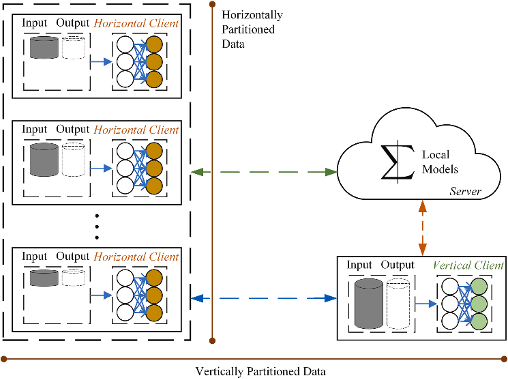
Interaction between horizontal clients, vertical client, and the server.

Dr Amir Anees, PostDoc Researcher
South Western Sydney Cancer Services, NSW Health and Ingham Institute, Liverpool, New South Wales, Australia;
South Western Sydney Clinical Campus, School of Clinical Medicine, UNSW, Warwick Farm, New South Wales, Australia.