
Sourced by A/Prof Vanessa Panettieri, Editor (Educational), AFOMP Pulse
Welcome back to our Featured Papers section. Once again, we have explored the AFOMP journals: Physical and Engineering Sciences in Medicine, Journal of Medical Physics, and Radiological Physics and Technology, which continue to publish valuable contributions to our field and bring us novel and engaging content.
This issue highlights a range of themes across both established and emerging techniques. Total Body Irradiation (TBI), for example, remains a well-established treatment modality, yet its implementation still varies considerably between institutions. While recent developments have shifted practice from conventional extended SSD techniques to VMAT-based approaches, transforming what was traditionally an SSD setup into an isocentric solution, the conventional method remains an attractive and practical option for many centres. The work by Ganesh et al provides a clearly defined and practical framework for commissioning extended-SSD TBI, offering a structured pathway for centres introducing or refining this technique.
Turning to MRI-guided radiotherapy, Rezzoug and co-authors explore how magnetic fields, once the exclusive domain of imaging, can reshape electron beam behaviour in therapy. Using Monte Carlo simulations, they investigate how parallel magnetic fields influence dose conformity, effectively guiding electron beams into tighter, more controlled distributions. It is a compelling reminder that in MRI-guided radiotherapy, physics does not merely support clinical practice but it actively shapes it.
In the ever-fundamental area of dosimetry (always a favourite among our readers), recent papers reinforce a simple truth: even in a discipline built on precision, there is always more depth to explore, sometimes quite literally. The study by Moghaddasi et al examines the subtleties of photon beam dosimetry, challenging common assumptions regarding ion recombination and the effective point of measurement (EPOM). Their findings highlight how variations with depth can meaningfully influence what we are measuring.
Finally, Miyauchi et al turn the spotlight to imaging dose in respiratory motion-tracking radiotherapy. While motion tracking represents a technological triumph, it carries the trade-off of additional kV imaging dose. This work provides a careful quantitative evaluation of entrance skin dose, exploring a component of treatment that often remains in the background but is essential to comprehensive patient dose assessment.
Happy reading! As always, we welcome your suggestions for topics to explore in future issues, and let us know if you would like your next paper to be featured in this section.
With contributions kindly provided by Sadia Aftab, Medical Physicists, Peter MacCallum Cancer Centre (Australia)
1) Focus on: specialised techniques
- TBI
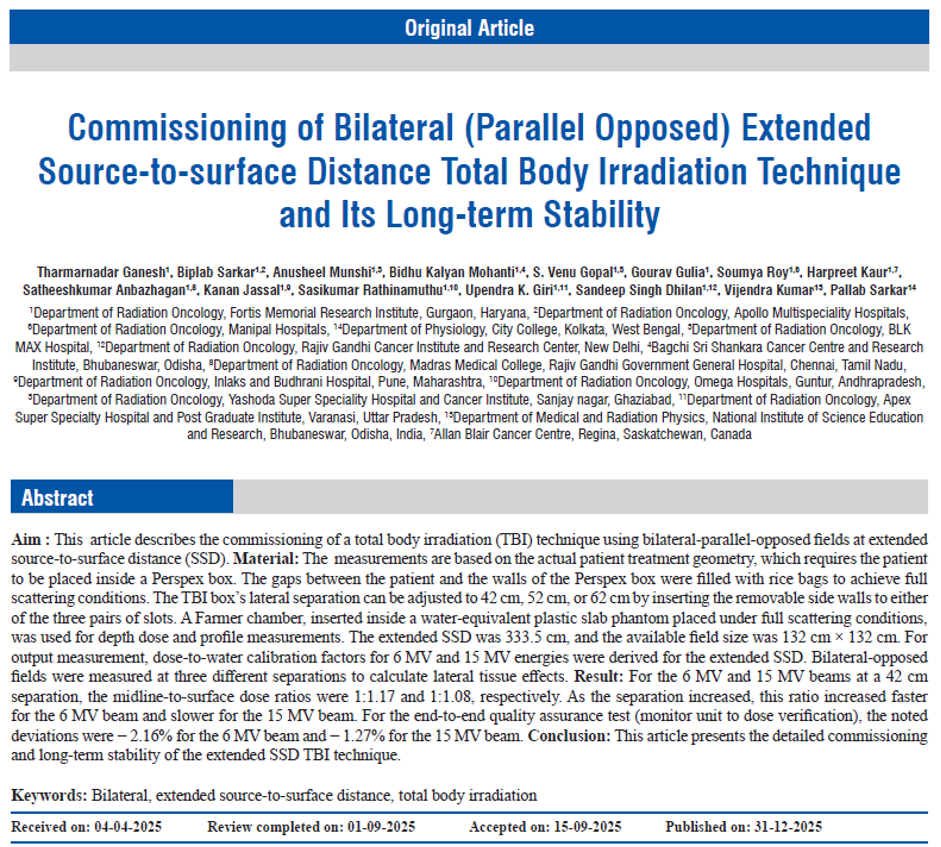
This article by Ganesh T et al., published in Journal of Medical Physics describes the commissioning, dosimetric characterisation, and long‑term stability of a bilateral (parallel‑opposed) extended source‑to‑surface distance (SSD) total body irradiation (TBI) technique implemented on an Elekta Synergy linear accelerator. The technique uses an extended SSD (>300 cm) and a specially designed Perspex TBI box filled with rice bags to ensure full‑scatter conditions and patient immobilization.
The study details all key dosimetric measurements – percentage depth doses (PDDs), beam profiles, output calibration, cross‑calibration factors, and monitor‑unit (MU) verification – for both 6 MV and 15 MV photon beams. Results showed predictable depth‑dose behaviour, clinically acceptable beam flatness, and stable dose delivery across patient separations, ranging from thin to large. End‑to‑end testing using a Rando phantom demonstrated dose deviations of only −2.16% (6 MV) and −1.27% (15 MV) from expected values, confirming accurate MU calculation and delivery. Long‑term quality assurance over five years showed consistent dose‑per‑MU stability.
Overall, the article provides a comprehensive commissioning workflow for centres wishing to implement extended‑SSD TBI, demonstrating that the technique is simple, robust, cost‑effective, and remains clinically relevant – especially in settings where advanced VMAT or Tomotherapy based TBI are not feasible.
- MRI-guided RT
DOI: 10.1007/s12194-026-01017-1
This very interesting study by Rezzoug M et al, published in Radiological Physics and Technology, presents a comprehensive analysis of how parallel magnetic fields can enhance the performance of clinical electron beams in MRI‑guided radiotherapy. Using extensive Monte Carlo simulations spanning magnetic field strengths from 0-3 T, electron energies of 6, 12, and 15 MeV, and clinical field sizes ranging from 3 × 3 to 15 × 15 cm², the authors systematically evaluated how magnetic confinement alters depth‑dose characteristics, lateral spread, and dose conformity. Their results demonstrate that parallel magnetic fields produce substantial beam sharpening, reducing lateral penumbra by 32-50% and improving field conformity through helical confinement of electrons, without inducing the problematic electron return effect observed in perpendicular MRI‑Linac geometries. Low‑energy electrons (6 MeV) exhibited stable and predictable dosimetric behaviour across all tested field strengths, while higher energies showed field‑size‑dependent variability. Importantly, the study identifies an optimal operating window around 1.5-2 T, where the balance between effective lateral confinement and beam stability is maximized.
The authors also acknowledge several limitations that influence interpretation and future clinical translation. Although homogeneous water phantoms were essential for initial dosimetric mapping, they do not replicate the anatomical complexity of real patients, particularly at interfaces where magnetic‑field‑sensitive dose perturbations may arise. The simulations further assume a perfectly uniform magnetic field, whereas actual MRI‑Linac systems incorporate gradient fields that can affect electron trajectories and dose distributions. Additionally, secondary particle transport and scatter within heterogeneous tissues (e.g., lung-bone interfaces) may differ from simulated behaviour. The study remains purely theoretical, as it lacks experimental measurements that are necessary to validate the Monte Carlo predictions. Finally, the simulations do not incorporate patient‑specific anatomy, motion, or realistic treatment‑planning constraints, meaning further refinement and integration into clinical systems is required before practical implementation.
Overall, the findings demonstrate that parallel magnetic fields can significantly improve dose precision and conformity in MRI‑guided electron therapy, offering a promising pathway for future MRI‑Linac development and potentially enabling reduced treatment margins and improved clinical outcomes.
2) Focus on: dosimetry
- Reference dosimetry
DOI: 10.1007/s13246-026-01709-3
This study by Moghaddasi L et al, published in Physical and Engineering Sciences in Medicine, investigates how ion recombination and effective point‑of‑measurement (EPOM) assumptions influence the accuracy of percentage depth dose (PDD) measurements in megavoltage photon beams, with a particular focus on flattening filter‑free (FFF) beams where dose‑per‑pulse (DPP) is high. Using three ionisation chambers (ROOS, SNC125, CC13), the authors experimentally characterised depth‑dependent ion recombination correction factors (ks) across multiple beam energies and field sizes using the two‑voltage method. They also derived empirical EPOM values by aligning chamber depth‑ionisation curves with a reference plane‑parallel chamber.
The results show that ks varies significantly with depth, especially for the CC13 chamber and in FFF beams, producing PDD deviations up to 1.3% at deep depths in a 10 FFF beam. EPOM shifts for cylindrical chambers were consistently smaller than the commonly assumed 0.6×rcyl, with normalised values of 0.42 (SNC125) and 0.38 (CC13). Using the generic shift introduced a residual dose deviation of approximately −0.5% PDD.
Combined effects of uncorrected recombination and nominal EPOM assumptions produced systematic deviations approaching 0.8% at 10 cm depth, relevant for reference dosimetry and treatment‑planning system (TPS) beam modelling.
The study concludes that detector‑specific, depth‑resolved ks corrections and empirically determined EPOM values significantly improve PDD accuracy, especially in FFF beams and should be incorporated into commissioning workflows and considered for inclusion in future ACPSEM guidelines.
- Imaging dose

DOI: 10.1007/s12194-025-00975-2
This study by Miyauchi et al, published in Radiological Physics and Technology, evaluates the entrance skin dose (ESD) patients receive from frequent kV X‑ray imaging during respiratory motion‑tracking radiotherapy delivered on the Radixact Synchrony system. By analysing data from 108 patients, the authors found that imaging sessions involved an average of 1230 exposures, resulting in a mean cumulative ESD of 69.1 mGy, with individual cases reaching up to 367.2 mGy. After accounting for overlapping imaging fields and exit dose, the maximum estimated total imaging‑related skin dose was approximately 952 mGy, equivalent to roughly 2% of the therapeutic skin dose in most patients. Even in scenarios with very high imaging frequency, these doses remained below guideline recommended safety thresholds.
The study has several limitations: cumulative skin dose was estimated using simplified geometric assumptions rather than more precise methods such as Monte Carlo simulations; dose attenuation from the treatment couch was not considered, potentially resulting in slight overestimation; and the study did not evaluate optimisation strategies such as reducing imaging angles, adjusting imaging frequency, or implementing low‑dose protocols. As a retrospective analysis, it was also subject to variability in patient anatomy, positioning, respiratory patterns, and tracking model behaviour, all of which may influence imaging dose.
Overall, the authors conclude that although kV imaging contributes additional radiation exposure, the associated skin dose is generally low, clinically acceptable, and consistent with previous findings, while emphasising the importance of continued monitoring and optimisation in cases requiring unusually frequent imaging.