David Sutton, Chair ICRP Committee 3 & Colin Martin, Chair ICRP Task Group 108
ICRP have very recently released Publication 160, ‘Practical Aspects in Optimisation of Radiological Protection in Digital Radiography, Fluoroscopy, and CT’. It is the second of two complimentary publications, the first being Publication 154’ ‘Optimisation of Radiological Protection in Digital Radiology Techniques for Medical Imaging’
Taken together, ICRP Publication 154 and 160 provide a comprehensive approach to the optimisation of radiological protection in digital radiology. Publication 154 describes a strategic framework to assist radiology and management staff in optimising radiological protection for imaging. Publication 160 deals with practical requirements for optimisation of different digital radiology modalities, and builds on information provided in earlier modality specific ICRP publications.
Publication 154 explores concepts surrounding the various strategic components surrounding optimisation of protection in digital radiology, namely Professionalism, Methodology and Process. It develops a framework that describes how imaging professionals should work together and details the benefits of having appropriate methodologies to monitor performance, together with the knowledge and expertise required to use them effectively. It describes how optimisation can be developed from an initial level D when a facility is set up, to the basic requirements of optimisation level C, through the intermediate level B, to advanced processes of optimisation termed level A (see figure).
Publication 160 translates the strategic ideas of 154 into modality‑specific, real‑world requirements. It provides information on practical methods needed to carry optimisation forward for different imaging techniques; radiography, fluoroscopy (including fluoroscopically guided interventional procedures) and CT. The publication acknowledges that there is a wide range in available equipment and training around the world, which presents challenges in communicating requirements for optimisation. This publication attempts to address these challenges by providing information for facilities, within the broad categories, D, C, B and A developed in Publication 154.
The intention is that a continuum of facilities ranging from less well-resourced clinics to major academic centres can use the same framework, but at different levels of sophistication. The combined 154/160 framework provides a scalable, adaptable, and globally relevant approach to the optimisation of radiological protection.
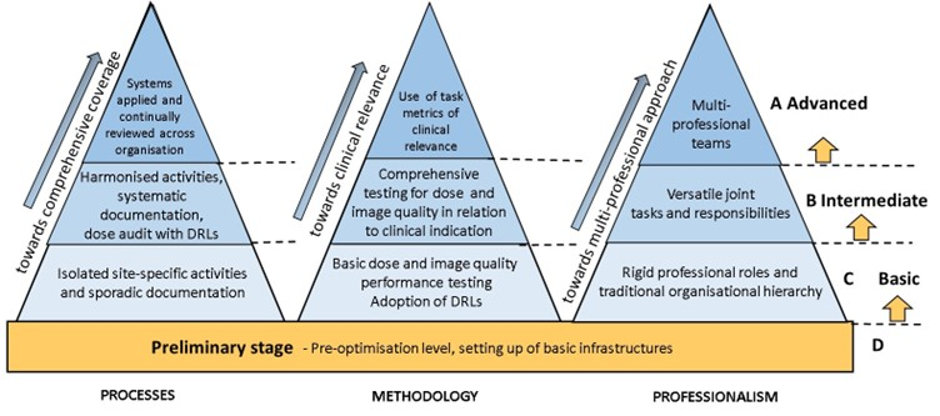
Figure- The three core components involved in developing and maturing optimisation. Processes appear on the left, since once the system is established, they drive the execution of other tasks. The levels denote progressive stages of achievement, ascending from Level D to Level A. Level D marks the foundational infrastructure required before the optimisation process can begin. Levels A, B, and C then describe the arrangements that will be in place for each component as that level is reached.
Both documents were authored / edited by Dr C Martin. Other contributing authors were (in alphabetical order) . Dr K. Applegate, Prof J Damilakis Dr I. Hernandez-Giron, Dr D. Husseiny, Dr H Khoury, Prof M. Kortesniemi, Prof KH Ng, Mr D Pekarovic Dr M. Del Rosario Perez, Prof D.G. Sutton, Prof J. Vassileva