
Tackling Complexity with Better Tools
Retreatment cases are a sign of progress for modern oncology – more patients are overcoming cancer and surviving longer after treatment. With this improvement in patient outcomes, the number of patients who require second (or even third, fourth, and beyond) rounds of treatment is increasing. Survivors are at risk for recurrence of the original disease and have a higher risk of new primary cancers [1]. A 2023 study across 8 clinics found that approximately 24% of patients were undergoing retreatment or palliative reirradiation, underscoring the growing importance of these complex clinical workflows [2].
Retreatment cases come with all the challenges of the initial course of treatment, and more. As these cases grow, there is a clear need for evidence-based, repeatable courses of action for different primary sites, as well as better planning that accounts for specific recovery rates for organs at risk [3]. Complexities such as anatomical changes, different image datasets, variable treatment intervals, and uncertainties associated with deformable registration add further complications to the mix. Clinicians have a responsibility to safely and effectively manage the complexity associated with retreatment cases.
Retreatment Presents Unique Challenges
Prior treatment introduces increased uncertainty around treatment planning and delivery. Patient anatomy changes over time, which makes following accumulated doses more challenging. Tumor regression, weight loss, surgery, and normal anatomical changes all impact the relationship between targets and surrounding tissues.
In cases of retreatment, clinicians must account for the length of time between treatments and how that impacts the recovery of nearby OARs. Even when treating different primary sites, there can be overlap of OARs and affected tissues. The challenge is further compounded when patients have received multiple treatment courses with different fractionation schedules, making cumulative dose assessment more complex than simply summing physical dose distributions. The need to quantitatively plan around cumulative doses to maximize tumor control with the tolerance of previously irradiated tissues remains one of the most significant challenges in modern retreatment practice [4].
Software That Meets the Current Moment
Advances in imaging, deformable registration, and biological dose evaluation help address many of the challenges associated with retreatment. Radformation has expanded the capabilities of AutoContour and ClearCheck to improve workflows around anatomical alignment, cumulative dose assessment, and plan evaluation.
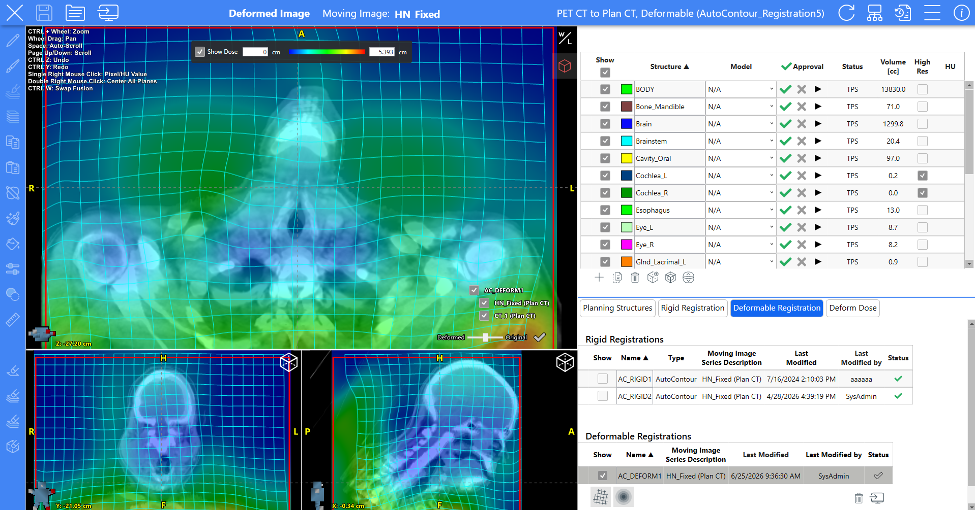
The recent merger with Limbus Contour vastly expands the number of models available for automatic, reliable AI-driven contouring for CT, MR, and CBCT workflows. Beyond automated contour generation, AutoContour includes rigid and deformable image registration along with integrated visual quality assurance tools. This empowers clinicians to follow anatomical changes between treatment courses and review registrations before they are used for downstream dose assessment. Further, deformed image datasets can then be transferred directly to ClearCheck for cumulative dose evaluation. AutoContour equips teams with the tools they need to follow patient anatomy over time in complex retreatment cases.
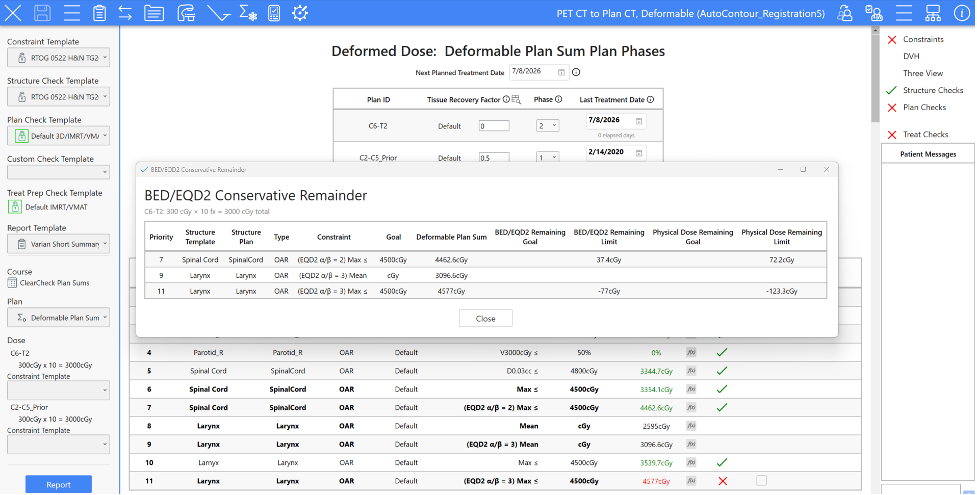
The latest ClearCheck version includes new tools to better handle the nuances of retreatment. Create plan sums using the deformed dose information imported from AutoContour, compare plans, and evaluate the impact of cumulative dose using organ-specific recovery factors obtained from the leading research out of the University of Michigan [5]. Follow your plan phases carefully with automatically loaded treatment dates and previous plans. ClearCheck always offers an extensive list of constraint, structure, plan, collision, and prescription checks, so every plan you review is comprehensive. With added visualization tools for BED/EQD2 dose delivery, you can track and review cumulative dose plans more clearly than ever.
BED EQD2 conservative remainder CC.png
Complex Cases Made Clearer
As the number of patients undergoing retreatment continues to rise, these cases grow more common and require tools to help handle the inherent complexity. AutoContour and ClearCheck support the evaluation of cumulative dose in complicated retreatment cases. Equip your radiotherapy department with manageable, automated workflows that enable reproducible approaches to contouring and planning for reirradiation cases.
If you’re interested in learning how AutoContour and ClearCheck will transform your retreatment workflows, book a demo with a Radformation team member today.
[1] N.S. Wagle, et. al. Cancer treatment and survivorship statistics, 2025. CA: A Cancer Journal for Clinicians 75:4, 308-340 (2025). https://acsjournals.onlinelibrary.wiley.com/doi/full/10.3322/caac.70011
[2] M. Neilson, et. al. A comprehensive national audit of radiotherapy retreatment numbers, sites and indications. Acta Oncol. 64:872-878 (2025). https://pmc.ncbi.nlm.nih.gov/articles/PMC12278771/#T0002
[3] K.C. Paradis, et al. The Special Medical Physics Consult Process for Reirradiation Patients. Advances in Radiation Oncology 4, 559-565 (2019) https://www.advancesradonc.org/article/S2452-1094(19)30061-2/fulltext
[4] N. Andratschke, et. al. Reirradiation − still navigating uncharted waters?
Clinical and Translational Radiation Oncology 49, 100871 (2024) https://www.ctro.science/article/S2405-6308(24)00148-4/fulltext
[5] J.D. Nieto, et. al. Application of Standardized Tissue Repair Discount Factors to Guide Spinal Cord Dose in Reirradiation. International Journal of Radiation Oncology, Biology, Physics 120, 171 (2024) https://www.redjournal.org/article/S0360-3016%2824%2901147-7/fulltext