Sourced by A/Prof Rafidah Zainon, Editor (Professional), AFOMP Pulse
The safe management of radioactive waste remains a cornerstone of radiological protection practice worldwide. The International Commission on Radiological Protection (ICRP) has long provided guidance on the application of its system of protection to waste disposal and Publication 159 represents a significant update in this area. It focuses specifically on the principles and approaches for surface and near-surface disposal facilities, which are commonly used for low- and very-low-level radioactive waste.
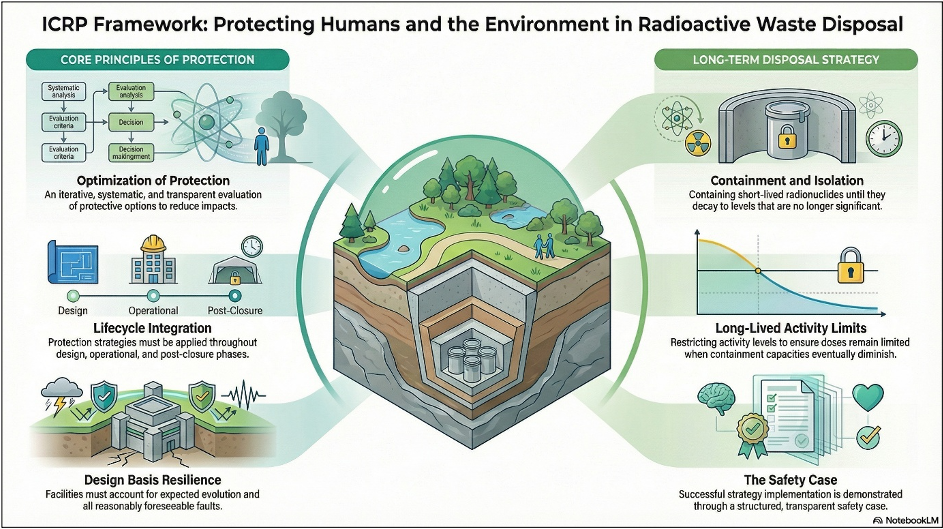
Figure 1: The ICRP framework for protecting humans and environment in radioactive waste disposal.
Fundamental Principles
ICRP Publication 159 reaffirms the application of the three pillars of radiological protection including justification, optimisation and dose limitation, to waste disposal practices.
- Justification ensures that the generation and disposal of radioactive waste is part of a practice that delivers net benefit to society.
- Optimisation requires a systematic, iterative and transparent evaluation of protective measures to reduce impacts to humans and the environment.
- Dose limitation ensures that exposures remain within internationally accepted thresholds.
Design Basis and Safety Considerations
The design of a disposal facility must anticipate its expected evolution and account for reasonably foreseeable faults. Optimisation is particularly critical during the design phase, as this determines the facility’s long-term performance. To address uncertainties in distant future scenarios, the ICRP emphasises complementary strategies such as:
- Robustness of engineered barriers
- Defence in depth to provide multiple layers of protection
- Structured safety cases to demonstrate compliance and confidence in long-term safety
Managing Different Exposure Situations
While disposal facilities are considered within the framework of planned exposure situations, the ICRP also provides guidance for existing exposure situations that may arise from severe natural events or human intrusion beyond the design basis. This dual approach ensures flexibility in protecting both present and future generations.
Strategic Approach for Low- and Very-low-level Waste
The fundamental strategy for these waste categories is twofold:
- Contain and isolate waste until short-lived radionuclides decay to insignificant levels.
- Limit activity content of longer-lived radionuclides to ensure doses and risks remain controlled even as containment capacity diminishes over time.
Stakeholder Engagement and Ethical Dimensions
Publication 159 highlights the importance of early dialogue among operators, regulators, and stakeholders. Ethical values such as fairness, sustainability and intergenerational responsibility are integral to building trust and promoting a shared understanding of radiological protection principles. This collaborative approach strengthens the legitimacy and acceptance of disposal strategies within society.
Professional Scope and Implications
For medical physicists, radiation protection professionals and waste management specialists, ICRP Publication 159 provides a clear framework to:
- Integrate radiological protection principles into facility design and operation
- Develop transparent safety cases that withstand regulatory and public scrutiny
- Engage meaningfully with stakeholders to ensure ethical and socially responsible outcomes
By reinforcing optimisation, defence in depth and stakeholder dialogue, the ICRP underscores that radiological protection is not only a technical discipline but also a societal commitment. The publication thus serves as a vital reference for professionals tasked with safeguarding both people and the environment in the context of radioactive waste disposal.
For further information, reader may browse and read the following reference:
- ICRP, 2024. Radiological protection in surface and near-surface disposal of solid radioactive waste. ICRP Publication 159. Ann. ICRP 53(6).