1,2Mohamaad Ullah Shemanto, 1Md. Jabidul Islam
1South Asia Centre for Medical Physics & Cancer Research (SCMPCR)
2Evercare Hospital Chattogram
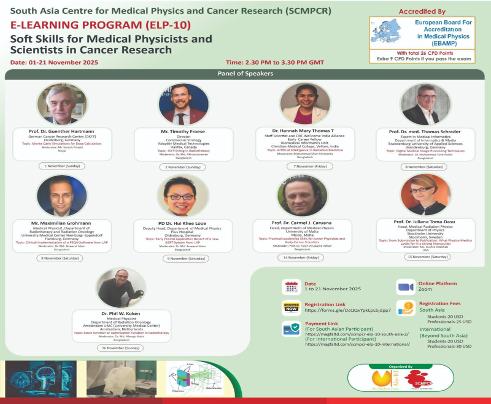
The South Asia Centre for Medical Physics and Cancer Research (SCMPCR) successfully conducted its 10th E-Learning Program (ELP-10) from 1 to 21 November 2025. Titled “Soft Skills for Medical Physicists and Scientists in Cancer Research,” the program integrated professional development with technically advanced topics essential for modern cancer care.
Accredited by the European Board for Accreditation in Medical Physics (EBAMP), the course awarded up to 35 Continuing Professional Development (CPD) points. The program achieved significant global reach, attracting 62 participants from 22 countries across South Asia, Southeast Asia, the Middle East, Europe, Africa, and Australia.
Day 01: Monte Carlo Simulations for Dose Calculation
Speaker: Prof. Dr. Guenther Hartmann, German Cancer Research Center (DKFZ), Heidelberg, Germany.
Moderator: Mr. Suresh Poudel, Medical Physicist, BPKMCH, Bharatpur, Nepal.
Prof. Hartmann presented this session, which was moderated by Mr. Suresh Poudel. The lecture provided a strong conceptual and practical understanding of stochastic dose calculation methods while clarifying the limitations of analytical algorithms. Participants gained clinical insight into Monte Carlo methods for heterogeneous media and small-field dosimetry, improving their confidence in evaluating accuracy for advanced techniques.
Day 02: Three-Dimensional Printing in Radiotherapy
Speaker: Mr. Timothy Froese, Director of Commercial Strategy, Adaptive Medical Technologies, Halifax, Canada.
Moderator: Dr. Md. Akhtaruzzaman, Chief Medical Physicist and Radiation Safety Officer, Evercare Hospital Chattogram, Bangladesh.
Mr. Froese led the session, moderated by Dr. Md. Akhtaruzzaman. It demonstrated how additive manufacturing integrates into radiotherapy workflows for patient-specific bolus design, immobilization, and QA phantoms. The discussion highlighted innovative, cost-effective solutions applicable to resource-limited settings.
Day 03: Artificial Intelligence in Radiation Medicine
Speaker: Dr. Hannah Mary Thomas T, Staff Scientist and DBT–Welcome India Alliance Early Career Fellow, Biomedical Informatics Unit, Christian Medical College, Vellore, India.
Moderator: Mohammad Ullah Shemanto, Medical Physicist, Evercare Hospital Chattogram, Bangladesh.
Dr. Hannah delivered a comprehensive overview of AI applications, moderated by Mohammad Ullah Shemanto. The lecture covered image segmentation, outcome prediction, and workflow automation. Participants gained clarity on data requirements, validation, bias, and interpretability to better engage with research literature.
Day 04: Digital Medical Image Processing Techniques
Speaker: Prof. Dr. med. Thomas Schrader, Expert in Medical Informatics, Department of Informatics and Media, Brandenburg University of Applied Sciences, Germany.
Moderator: Md. Motiur Rahman (Mithu), Chief Medical Physicist & Assistant Project Director TMSS Cancer Centre (TCC).
Prof. Thomas Schrader focused on image filtering, feature extraction, and quantitative analysis, with Md. Motiur Rahman moderating. The session established clear links between digital processing, radiomics, adaptive radiotherapy, and imaging-based biomarkers in cancer research.
Day 05: Clinical Implementation of PSQA Software and SGRT Systems
Speakers: Mr. Maximilian Grohmann, Medical Physicist, Department of Radiotherapy and Radiation Oncology, University Medical Center Hamburg-Eppendorf, Germany &
Dr. Hui Khee Looe, Deputy Head, Department of Medical Physics, Pius-Hospital, Oldenburg, Germany.
Moderator: Dr. Anwarul Islam, Coordinator Medical Physicist, Square Hospitals Ltd, Dhaka, Bangladesh.
Mr. Maximilian Grohmann and Dr. Hui Khee Looe presented practical strategies for commissioning and workflow integration, moderated by Dr. Anwarul Islam. Participants reviewed early clinical experiences and safety considerations necessary for implementing patient-specific QA and surface-guided radiotherapy systems.
Day 06: Practical Leadership Skills for Junior Physicists
Speaker: Prof. Dr. Carmel J. Caruana, Head, Department of Medical Physics, University of Malta, Msida, Malta.
Moderator: Meher Nigar Sharmin, Medical Physicist, Khwaja Yunus Ali Medical College and Hospital (KYAMCH Cancer Center), Enayetpur, Sirajganj, Bangladesh.
Prof. Caruana addressed leadership, communication, and career development, with Meher Nigar Sharmin moderating. The session emphasized the growth of soft skills alongside technical expertise within clinical and academic environments.
Day 07: From Submission to Publication
Speaker: Prof. Dr. Iuliana Toma-Dasu, Head of Medical Radiation Physics, Department of Physics, Stockholm University, Sweden, and Chief Editor of Physica Medica.
Moderator: Ms. Bushra Intakhab, Department of Physics, Florida Atlantic University, USA.
Prof. Toma-Dasu provided practical insights into manuscript preparation and peer review expectations, moderated by Ms. Bushra Intakhab. The discussion covered common rejection reasons and ethical reporting to support participants’ research and publication efforts.
Day 08: Optimization and Score Functions in Radiotherapy
Speaker: Dr. Phil W. Koken, Medical Physicist, Department of Radiation Oncology, Amsterdam UMC, Netherlands.
Moderator: Dr. Md. Alamgir Kabir, Associate Professor, Department of Physics, Jahangirnagar University, Savar, Dhaka.
Dr. Phil explored objective functions and trade-offs in inverse planning, moderated by Dr. Md. Alamgir Kabir. The session strengthened participants’ ability to critically interpret treatment plans by highlighting the limitations of automated optimization.
Day 09: Group Discussion and Interactive Exchange
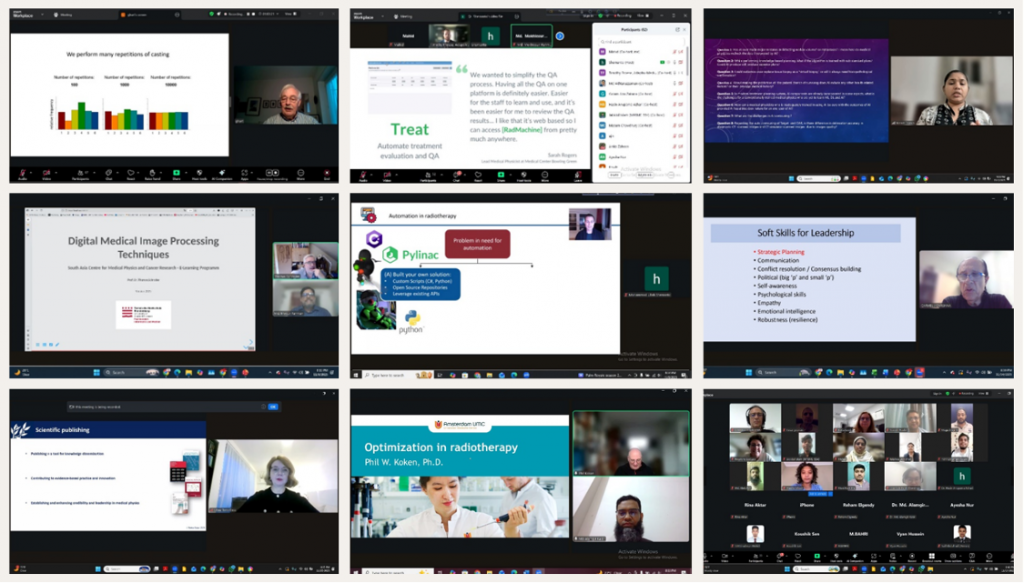
The program concluded with a dynamic forum moderated by Dr. Raju Srivastava and Dr. Mary Joan, who also serves as Co-Editor-in-Chief of the SCMPCR Newsletter. This session allowed for direct, enthusiastic dialogue between participants, faculty, and a representative from LAP regarding vendor-specific inquiries. By addressing clinical challenges and research barriers in real-time, the exchange fostered peer learning and international collaboration, effectively bridging the gap between theoretical knowledge and practical professional growth.
Participant Evaluation and Feedback
Evaluations indicated high satisfaction with the program’s organization and its balance between technical depth and professional development. Participants specifically noted increased confidence in utilizing Monte Carlo methods, AI, and modern QA systems. While the leadership and publication-focused sessions were highly valued for addressing professional challenges, constructive feedback suggested adding more hands-on components and case-based discussions in future iterations to further enhance the learning experience.
Examination Outcomes and Recognition of Excellence
A formal online examination on 21 November 2025 resulted in an impressive average score of 84.7% (33/40). Top honors with a score of 38/40 were awarded to Ayesha Nur, Bushra Intakhab, and Sakhi Sara. Second-place honors (37/40) went to Morium Akter, Ahlam Azalmad, Saloni Chawla, Sheikh Faysal, Haritha Karunarathne, Suresh Poudel, and Sumaya Sumaya. Third-place (36/40) was shared by Safwan Araf Alvey, Jose Luis Paolo Domingo, and Md. Mokhlesur Rahman. These results confirm effective knowledge transfer across the diverse global cohort.
Mentorship and Ongoing Engagement
To foster future leadership, top-ranked participants have been invited to serve as SCMPCR Moderators and Ambassadors. A dedicated mentorship group has been established to provide ongoing academic guidance and pathways for active involvement in research and outreach. This initiative aims to transform academic success into long-term professional contributions, ensuring a sustained global network of skilled medical physicists.
Conclusion
ELP-10 successfully integrated advanced technical training with essential soft skills, supporting the professional readiness of medical physicists worldwide. SCMPCR remains committed to providing inclusive, high-quality education that empowers scientists to lead innovation and ensure safe clinical practice in global cancer care.