
Recently Prof. Ni Xinye’s lab has published an article “In vivo 3D dose distribution verification for lung cancer: from rigid-body model to porcine lung” on Bio-Design and Manufacturing.
(Zhang Y, Xie K, Song L, et al., 2025. In vivo 3D dose distribution verification for lung cancer: from rigid-body model to porcine lung. Bio-design Manuf 8(6):994 – 1008. https://doi.org/10.1631/bdm.2500077, JCR Q1 top, 18/124, IF=7.6).
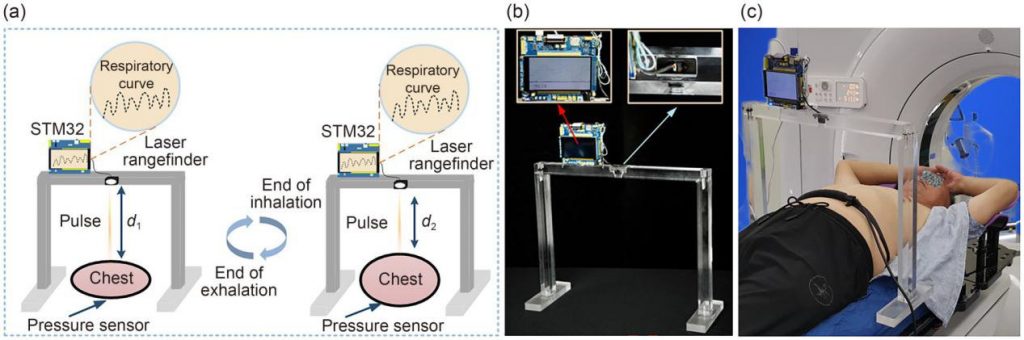
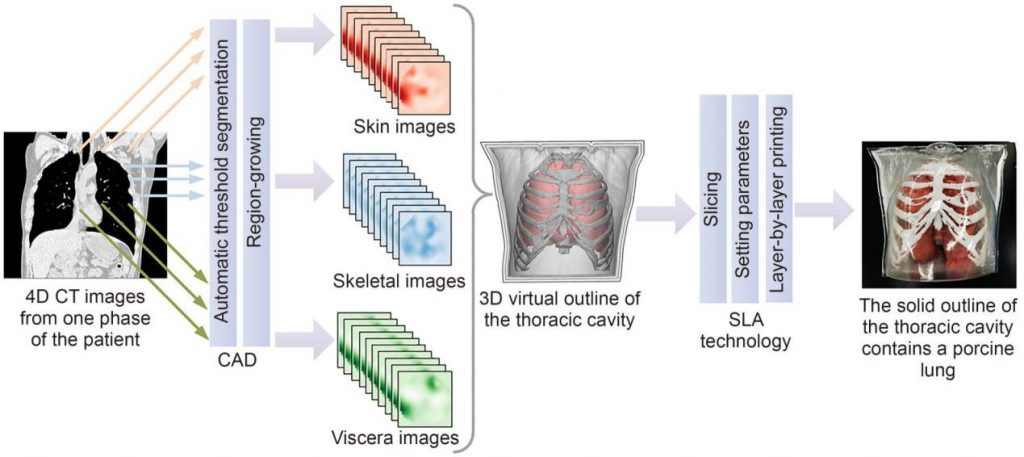
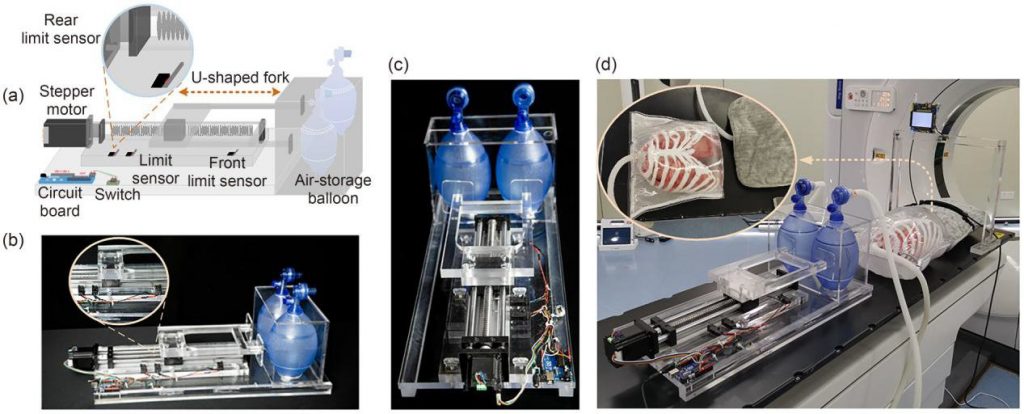
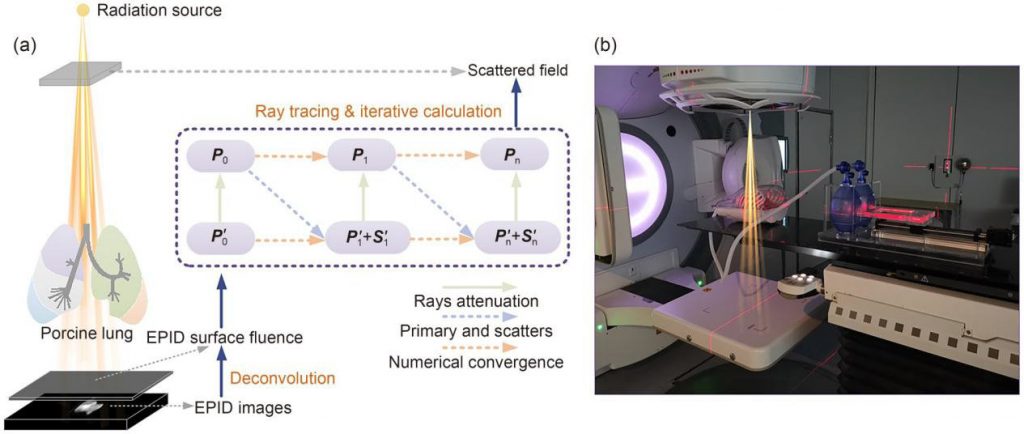
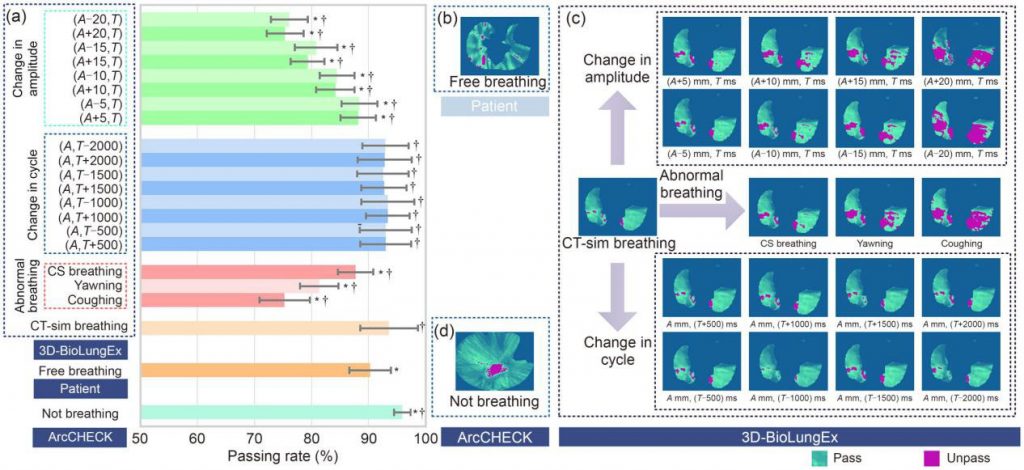
This paper focuses on the validation of 3D dose distribution in lung cancer. The study proposes a novel concept of in vivo 3D dose distribution verification, aiming to investigate the impact of respiratory movement on accuracy of lung cancer radiotherapy dose delivery. It breaks through the limitation of the traditional rigid body dose distribution verification. They have developed a 3D BioLungEx device to accurately replicate the respiratory motion characteristics of lung cancer patients. By using biological image registration, the patient treatment plan is transplanted into a fresh live pig lung that matches the anatomical structures. Based on the patient’s CT images, a chest cavity is 3D printed to carry the fresh pig’s lung. Using 3D BioLungEx to simulate various respiratory patterns that may be observed during the patient’s treatment cases including the normal breathing, the tidal breathing, the yawning, and coughing. After completing the plan adjustment based on the Monaco treatment planning system, a self-developed iterative optimization scattering inversion dose distribution algorithm (IOSI BLDose) specifically designed for pig lungs was used to calculate the 3D dose distribution in the pig lungs during radiotherapy real timely. Select gamma pass rate to quantify the difference between the dose distribution and the dose distribution in the radiotherapy plan. The results showed that when replicating the patient’s respiratory state during simulated localization, the gamma passing rate reaches 93.61%, while abnormal respiratory patterns caused the gamma passing rate drop to below 90%. Respiratory amplitude was the main factor affecting dose delivery accuracy, while changes in respiratory frequency had a relatively small impact on gamma passing rate. The in vivo 3D dose distribution verification proposed in this study can provide real-time biological feedback and is more sensitive to detecting dose deviations caused by motion than traditional rigid body verification. It provides important technical support for improving radiotherapy accuracy and promoting personalized adaptive radiotherapy.

Prof. Ni Xinye is the Second-grade Professor and the Doctoral Supervisor. He is currently the Vice President of the Second Affiliated Hospital of Nanjing Medical University (Changzhou Second People’s Hospital, Jiangsu Province, China). He has assumed a series of important academic appointments both domestically and internationally, selectively list below:
- The Chief Scientist of the National Key R&D Program of China
- Vice Chairman of Radiation Medicine and Protection Branch, Chinese Medical Association
- Chairman of Radiation Medicine Protection and Technology Branch, Jiangsu Medical Association
- Member, Academic Committee, International Organization for Medical Physics (IOMP)
- Member, National Expert Committee on Radiotherapy Quality Control
- Director, Jiangsu Engineering Research Center of Medical Physics
- Director, Digital Intelligent Radiotherapy Technology Innovation Platform, Nanjing Medical University
- Director, Medical Physics Research Center, Nanjing Medical University
- Academic Leader, Jiangsu Key Medical Discipline during the 14th Five-Year Plan Period
- Standing Committee Member, Medical Physics Branch, Chinese Society of Biomedical Engineering
- Standing Committee Member, Radiotherapy Equipment Technology Branch, China Medical Equipment Association
- Standing Committee Member, Medical Physics Technology Committee, Chinese Anti-Cancer Association
- Standing Committee Member & Group Leader of Radiation Physics Group, Radiotherapy Branch, Jiangsu Medical Association
- Vice Chairman, Medical Physics Committee, Jiangsu Society of Biomedical Engineering
- Vice Chairman, Oncology Physics Technology Committee, Jiangsu Anti-Cancer Association
- Vice Chairman, Radiation Medicine Committee, Jiangsu Association of Research Hospitals
- Associate Editor, Technology in Cancer Research & Treatment
- Associate Editor, Frontiers in Systems Biology
- Editorial Board Member, Chinese Journal of Radiation Oncology
- More info can be found in https://bmei.njmu.edu.cn/2022/0919/c11345a221689/page.htm