Rajni Verma, Assistant professor, Department of Radiological Physics , SMS Medical College and Hospitals
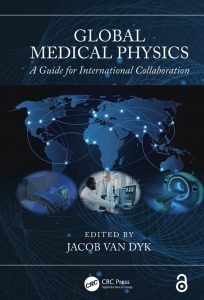
I picked up Global Medical Physics: A Guide for International Collaboration expecting a fairly dry policy document, and was pleasantly surprised to find something closer to a field manual written by people who have actually lived the work it describes. Edited by Jacob Van Dyk a name most of us in the international medical physics community already know from decades of outreach this newly released, open-access volume brings together 34 contributors from 21 countries across its 18 chapters. For AFOMP members working across some of the most diverse resource settings anywhere in the world, the book arrives at a genuinely useful moment. The chapters move through the full life cycle of a global partnership: building institutional relationships, engaging industry, mentoring, education and training, data sharing, ethics, and equity, diversity and inclusion, before closing with a summary of recommendations. It reads less like a textbook and more like a practical playbook for the exact work AFOMP exists to promote connecting institutions and individuals across the Asia-Oceania region and beyond, particularly where resources and training capacity remain thin.
The book’s opening chapter, Chapter 1, by Jacob Van Dyk and Francis Hasford, does the quiet, unglamorous work that every good introduction has to do: it sets the tone for everything that follows. Before making any argument, the authors slow down and define their terms global health, global medical physics, Global North and Global South, colonialism and neocolonialism so that readers from very different backgrounds are, quite literally, speaking the same language by the end of the first few pages. That care pays off once the numbers arrive. Drawing on the 2023 IOMP workforce survey, the chapter reports close to 30,000 medical physicists across 93 countries, notes that roughly 30,000 more will be needed by 2035, and lays out per-capita disparities that fall hardest on low- and middle-income countries. None of this is new information to anyone who has worked in this field for long, but seeing it collected, footnoted, and stated plainly in the book’s opening pages gives the rest of the volume its sense of urgency. It closes with ten recommendations that read almost like a table of contents in miniature a preview of the ethical, educational, and partnership themes the later chapters take up one by one.
That same thread of advocacy runs quietly through much of the book, and it surfaces directly in Chapter 11, written by Eva Bezak with Loredana Marcu and Ana Maria Marques da Silva. It makes a point worth sitting with: our profession does not advance on good equipment and good training alone, but also on the slower, less visible work of building relationships with policy-makers, funders, and institutions. Bezak whose own IOMP workforce survey underpins much of the book’s data elsewhere writes with the authority of someone who has done this work, not just studied it, and the chapter’s European, North American, and South American case studies, from EFOMP’s coordinated advocacy to Brazil’s long campaign for professional recognition, are well chosen and instructive.
The chapters in between carry that same spirit into other territory worth a reader’s time CERN’s model of large-scale international scientific partnership, the ethics of working across very different healthcare systems, and the growing conversation around equity and inclusion in global teams building steadily toward the chapter I found myself returning to most, Chapter 17, by Arun Chougule and Mary Joan. If Chapter 1 tells you why this work matters and Chapter 11 tells you how to argue for it, Chapter 17 is the one that tells you, very concretely, who to call and it earns the extra time it takes to read properly. The chapter opens by sorting the organizational landscape into clear families: professional societies (IOMP, AAPM, IPEM, HPS, alongside clinically aligned bodies like ASTRO and RSNA), academic and training institutions (the Abdul Salam ICTP and the ASEAN College of Medical Physics), governmental and intergovernmental agencies (above all the IAEA, through its Human Health Division), non-governmental organizations (IUPESM, Medical Physics for World Benefit, Radiating Hope, the South Asian Centre for Medical Physics and Cancer Research, RAD-AID International), and industry partners (Elekta, IBA, Philips, PTW, Sun Nuclear, Siemens Healthineers and Varian). A separate section walks through accreditation specifically, tracing how bodies like CAMPEP, ACPSEM, and EFOMP’s EBAMP sit alongside IOMP’s own accreditation board and its International Medical Physics Certification Board, which steps in to certify individuals in countries where no national board yet exists.
What makes the chapter genuinely useful rather than a glorified directory is that it does not stop at naming organizations it evaluates them. The authors are candid about trade-offs: professional societies set standards and offer valuable networking, but their benefits can end up concentrated among members in already well-resourced regions; academic institutions drive research and innovation but depend on uncertain external funding; governmental agencies bring real financial weight but move slowly through bureaucratic and regulatory processes; NGOs are often the ones actually reaching underserved regions, but they live and die by unpredictable donor funding; and industry partners bring technology and technical training, but their priorities can tilt toward the most profitable markets rather than the neediest ones. The chapter then grounds all of this in specific, current examples the IOMP’s triennial World Congress on Medical Physics and Biomedical Engineering and its annual International Day of Medical Physics, the Harvard Medical School Global Health Catalyst Summit’s work on telemedicine-enabled cancer care, the IAEA’s Human Health Campus and its Technical Cooperation Programme, the ICTP’s joint Master’s of Advanced Studies in Medical Physics run with the University of Trieste and over twenty partner hospitals, Radiating Hope’s equipment donation and training work, the International Cancer Expert Corps’ mentorship model, and Rayos Contra Cancer’s digitally delivered courses for Latin America. For readers across Asia and Oceania, this section reads almost like a map with the doors already marked: here is where to look for accreditation support, here for fellowships, here for equipment donation, here for mentorship.
The chapter closes with two distinct sets of recommendations that I suspect will be the most photocopied pages in the book. One set is addressed to the organizations themselves expand scholarships and grants for participants from developing countries, offer virtual participation options for conferences, standardize curricula and certification internationally, and improve coordination between organizations so that effort is not duplicated. The other is addressed to individual medical physicists, and it is refreshingly practical: identify the key organizations in your subfield and join them, volunteer for committees and working groups rather than staying a passive member, contribute to research collaborations and co-authored publications, take advantage of free training and webinars, write for organizational newsletters exactly like this one, and consider volunteer missions in disaster-affected or underserved areas. It is rare for a chapter this dense with organizational detail to end on something so immediately actionable, and it is the reason I expect readers will keep coming back to it long after they have finished the rest of the book.
Read cover to cover, Global Medical Physics builds a coherent argument that becomes especially clear once you notice how these three chapters sit in relation to one another. Chapter 1 makes the case for why global collaboration matters and where the gaps still lie; Chapter 11 shows how advocacy and diplomacy create the political and institutional space for that collaboration to actually happen; and Chapter 17, the chapter I would most readily hand to a colleague, supplies the practical directory of organizations, activities, and next steps through which that collaboration gets carried out in real life. Around them, the other fifteen chapters fill in the operational detail a working medical physicist will eventually need once those doors are open career pathways, mentoring models, industry partnerships, data-sharing frameworks, the growing role of artificial intelligence, and a good deal of hard-won, practical wisdom about sustainability and ethics. What stayed with me after finishing the book is not any single statistic or recommendation, but the sense that this really was written by and for people doing this work, not observing it from a distance. The open-access status, the CC BY-ND licensing of individual chapters, and the consistent attention to LMIC perspectives all make it an unusually accessible and genuinely useful resource rather than an academic exercise. For AFOMP members whether you are an early-career physicist looking for a mentor, a department head trying to negotiate an equipment donation, or a national society leader thinking through an advocacy strategy this is a book worth keeping close at hand, and one I would happily recommend to any colleague about to start their first international collaboration.