
Jiayun Chen, Department of Radiation Oncology, National Cancer Center / Cancer Hospital, Chinese Academy of Medical Sciences,
Nan Zhang, Beijing Daily
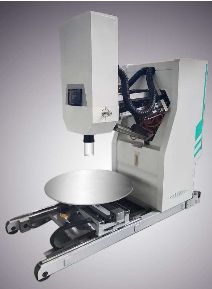
For nearly two decades, Prof. Jianrong Dai of the Cancer Hospital, Chinese Academy of Medical Sciences (CAMS), has led a mission to transform intraoperative radiation therapy (IORT) in China. In 2024, that vision materialized: the first domestically developed IORT robot prototype, assessed as world-leading by national expert panels, was unveiled after 17 years of persistent R&D.
From Clinical Frustration to Innovation
Prof. Dai’s journey began with a clinical problem. Since 2006, Chinese oncologists relied on imported IORT accelerators weighing over 1,600 kg and requiring multiple operators to manually position the treatment head. Dose calculation depended on visual estimation, making the procedure labor-intensive and highly experience-dependent. Prof. Dai recognized that true progress required an entirely new approach—one that combined robotics, precision engineering, and medical physics.
In 2015, he assembled a cross-disciplinary R&D team spanning CAMS Cancer Hospital, Tsinghua University, Beihang University, and six other institutions. As the clinical and scientific leader, Prof. Dai defined the system’s core requirements from a clinical perspective, ensuring that every engineering decision served clinical needs.
Overcoming Engineering Barriers
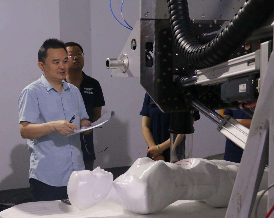
The development path was arduous. Early prototypes suffered from software-hardware incompatibility and mechanical precision errors. During one critical test, a robotic arm deviated and collided with a support structure. Prof. Dai’s team treated each failure as a learning opportunity, systematically refining synchronous control protocols, real-time compensation algorithms, and motion control systems. Through countless iterations, the team achieved stable, reproducible performance. In 2024, the system passed an authoritative national evaluation, with its technical capabilities recognized as world-leading.
Key Innovations Led by Prof. Dai
The robot introduces six transformative features directly addressing Prof. Dai’s original clinical vision:
- Lightweight Robotics: The 250 kg treatment head—operated by a single person via a six-axis robotic arm with flexible force guidance—replaces the multi-operator manual positioning of 1,600 kg legacy systems.
- IntraoperativeOpticalImaging:Aftertumorresection,fluorescenceimagingautomaticallydelineates the target volume, enabling true three-dimensional “dose painting” based on real-time tumor morphology.
- Cystic Applicator: Designed for cavity-based tumors (e.g., breast and brain), this applicator delivers dose conforming to the resection cavity’s curved surface.
- ScanningIORT:Followsapre-plannedscanpath,usingaparallelplatformtomovethetreatmenthead for precise scanning intensity-modulated electron therapy dose delivery.
- Flexible Force-Guided Positioning: Uses multi-axis force sensors to sense operator force, adjusting head pose via the parallel platform to improve setup accuracy and efficiency while reducing workload.
- Clinical Efficiency: A complete session requires only ~30 minutes, at roughly one-fourth the cost of conventional postoperative fractionated radiotherapy, while sparing surrounding healthy tissues.
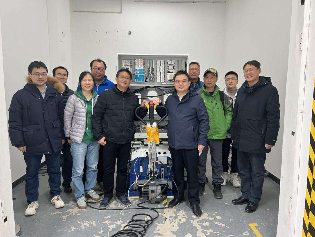
Conclusion: Prof. Jianrong Dai’s 17-year endeavor exemplifies how medical physicists can bridge clinical needs and engineering innovations. As the IORT robot advances toward clinical deployment, it stands as a testament to the impact of sustained, interdisciplinary leadership in radiation medicine. We welcome collaboration with AFOMP colleagues as this technology moves from the laboratory to the operating room.

- Deputy Director, Department of Radiotherapy, National Cancer Center / CancerHospital, Chinese Academy of Medical Sciences
- Doctoral Supervisor, Research Scientist
- Council member of the International Organization for Medical Physics (IOMP)
- President of Chinese Society of Medical Physics