Md. Jabidul Islam, Junior Program Officer, South Asia Centre for Medical Physics & Cancer Research (SCMPCR)
The South Asia Centre for Medical Physics and Cancer Research (SCMPCR), under Alo Bhubon Trust, successfully conducted its 9th Hands-on Workshop (HW-09), titled “Advances in Contemporary Cancer Care: Integrated Radiotherapy Practice for Medical Physicists and Radiation Oncologists.”
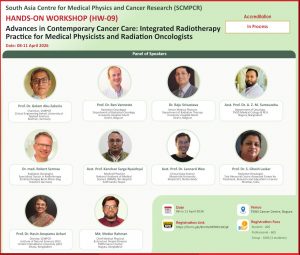
Designed to address the critical gap in skilled cancer care professionals across South Asia, the four-day intensive program focused on promoting collaborative clinical workflows between medical physicists and radiation oncologists to enhance treatment accuracy, safety, and efficiency.
- Delegates: 39
- Global Faculty: 12
- CPD Points: 40
Global Academic & Clinical Expertise
Led by SCMPCR Founder Chairman Prof. Dr. Golam Abu Zakaria and Director Prof. Dr. Hasin Anupama Azhari, the workshop convened a prestigious international faculty from Germany, Belgium, the Netherlands, India, Nepal, and the USA.
Key distinguished speakers included Dr. Robert Semrau (Germany), Prof. Dr. Ben Vanneste (Belgium), Asst. Prof. Dr. Leonard Wee (Netherlands), Prof. Dr. S. Ghosh Laskar (India), Shaju Pilakkal (India), Asst. Prof. Kanchan Sarga Nyaichyai (Nepal), and Charles Martel Ramota (USA), alongside clinical leadership from TMSS led by Chief Medical Physicist Md. Motiur Rahman.
- Institutional Collaborations: Organized in strategic cooperation with TMSS Cancer Center and supported by the International Cancer Expert Corps (ICEC), PTW, Beacon Pharmaceuticals PLC, Tradevision, Canon, and Radformation.
Day 1: Foundations & Tomotherapy Innovations
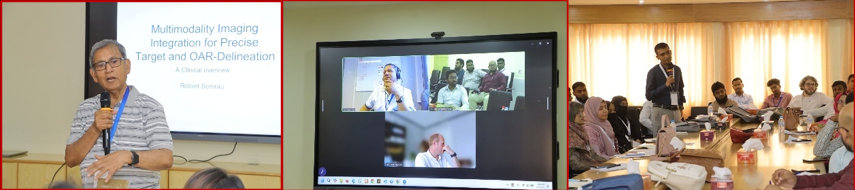
The workshop opened with technical lectures examining the medical, clinical, and physical principles of Tomotherapy compared to conventional Linacs. Experts detailed specialized commissioning, routine QA protocols, and multimodality imaging (CT-MRI-PET) integration for precise target delineation. An online presentation highlighted artificial intelligence applications in radiation medicine.
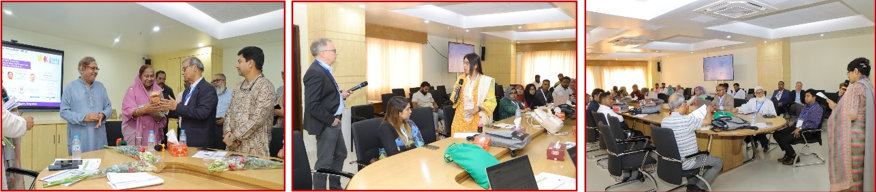
The formal inauguration was graced by Chief Guest Prof. Dr. MH Alamgir (Pavel) and TMSS Executive Director Prof. Dr. Hosne-Ara Begum, emphasizing regional clinical empowerment.
Day 2: Advanced Clinical Workflows & Planning
Day 2 emphasized high-precision strategies and treatment modalities:
- TBI Physics: Dosimetry, QA, and field planning for Total Body Irradiation.
- Radiobiology: Clinical rationale for Hypofractionation, SRS, and SBRT dose limits.
- Motion Management: Mitigating internal tumor motion risks during delivery.
- SGRT vs. Markers: Transitioning toward surface-guided radiation therapy to reduce invasive localization.
- Target Delineation: Head, neck, breast, and pelvic nodal contouring standards to minimize organ-at-risk toxicity.
Day 3: Hands-on Clinical Training
Participants transitioned into interactive, role-specific practical workstreams:
- Group A (Radiation Oncologists): Interactive live contouring exercises on complex clinical cases, guided by Dr. Robert Semrau and local faculty, focusing on target volumes and organ-at-risk sparing.
- Group B (Medical Physicists): Hands-on Tomotherapy commissioning, beam alignment verification, and quality assurance testing protocols utilizing TMSS facility infrastructure.
The session concluded with demonstrations on AI-driven treatment planning automation, followed by structured interdisciplinary panel discussions and a cultural excursion to the historic Mahasthangarh archaeological site.
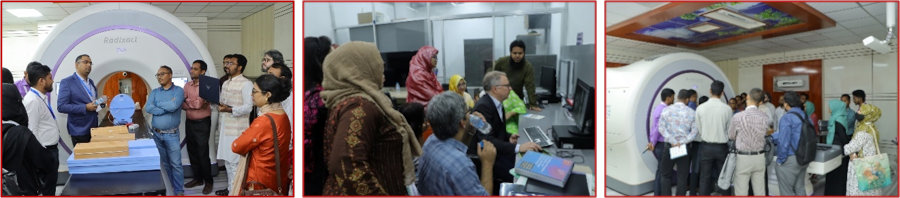
Day 4: Evaluation & Outcomes
The final day featured a comprehensive clinical examination assessing delegates on integrated workflows, contouring precision, and Tomotherapy physics. Certified attendees received 40 European Board for Accreditation in Medical Physics (EBAMP) CPD points during the closing ceremony, which was attended by Chief Guest Dr. Md. Enamul Haque (DG, Health Economics Unit).
- Participant Impact & Feedback: Participant evaluations demonstrated overwhelming satisfaction (87%+ rating content and faculty expertise as excellent/good). Key attendee recommendations highlighted requests for expanded hands-on dosimetry modules, AI coding applications (Monte Carlo/Geant4), and bi-annual workshop cycles.
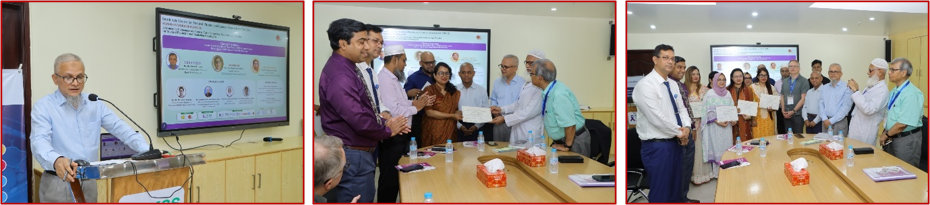
Conclusion HW-09 successfully reinforced interdisciplinary clinical collaboration, establishing actionable standards to advance radiotherapy accuracy and patient care across South Asia.